Understanding Inguinal Hernia
Understanding the symptoms, causes, and available treatment options is an important first step. Every patient is different, so the right treatment depends on individual symptoms and medical evaluation.
When Should You Consult a Doctor?
If symptoms continue, become severe, or start affecting your daily activities, it is important to consult a qualified medical professional for proper diagnosis and treatment.
You’re getting ready for the day or perhaps lifting a heavy grocery bag when you feel it—a slight tug, a strange pressure, or a visible groin bulge. For many men in Hyderabad, the first instinct is to brush it off. "It’s probably just a pulled muscle," you tell yourself. But if that lump lingers or pops out when you cough, it’s time to stop guessing. That "bulge" is often the first sign of a hernia. While it might start as a minor annoyance, ignoring it is like leaving a small crack in a dam. Understanding hernia symptoms in men is the first step toward reclaiming your comfort and preventing a medical emergency.
Is It a Hernia or a Pulled Muscle?
It is easy to confuse the two because both cause discomfort in the lower abdomen or pelvic region. However, there are telltale differences that a Hernia Specialist looks for during a diagnosis.
The Pull vs. The Protrusion
A pulled muscle (strain) is an injury to the muscle fibers. It typically happens after a sudden, sharp movement. The pain is usually constant, tender to the touch, and often improves with rest and ice over a few days. Crucially, a pulled muscle does not cause a physical lump.
A hernia, on the other hand, is a structural issue. It occurs when an internal organ or fatty tissue pushes through a weak spot in the surrounding muscle wall.
How to tell the difference:
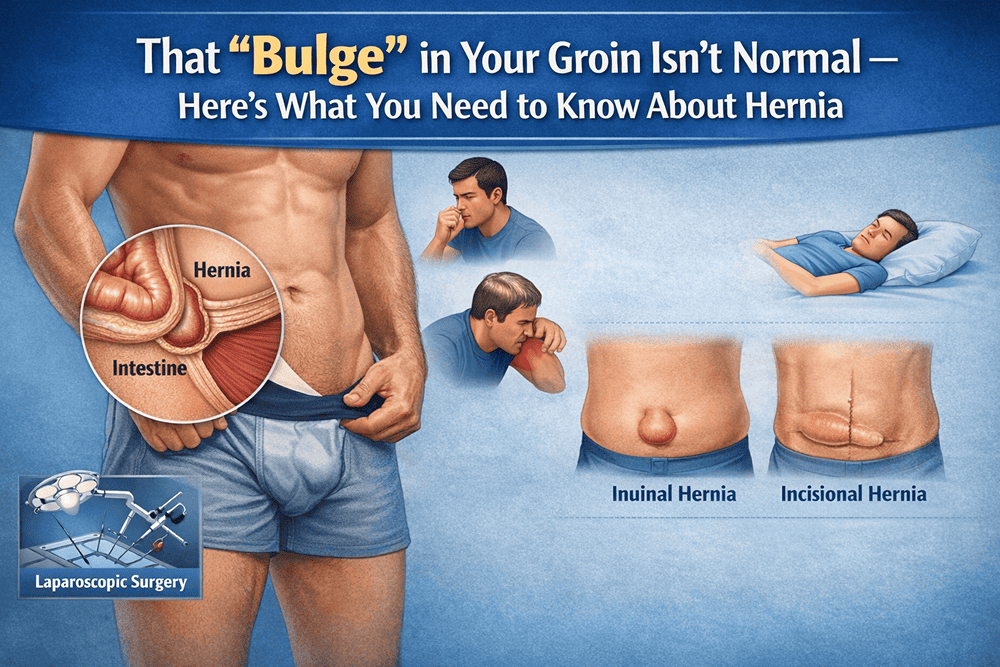
The "Cough Test": If you stand up and cough or strain, does the bulge become more prominent? If yes, it’s likely a hernia.
The Disappearing Act: Does the lump vanish or flatten when you lie down? Muscle strains stay the same; hernias often "reduce" or slide back in when gravity isn't pulling on them.
The Sensation: Hernia pain is often described as a "heavy" or "dragging" feeling, whereas a muscle strain feels like a sharp, localized sting.
Common Types of Hernia Observed in India
In our busy lives across cities like Hyderabad, certain hernias are more prevalent due to lifestyle factors, heavy lifting, or even chronic coughs (often linked to pollution or smoking).
1. Inguinal Hernia (The Groin Bulge)
This is the most common type, especially in men. It occurs in the inguinal canal—the area where the spermatic cord passes. Because this area is naturally weaker in males, inguinal hernia signs often include a bulge in the groin that may even extend down into the scrotum.
2. Umbilical Hernia (The Belly Button Bulge)
An umbilical hernia occurs near the navel. While common in infants, in adults, it is often triggered by obesity, multiple pregnancies, or previous abdominal surgeries. You'll notice a soft or hard hernia lump right at or next to your belly button.
3. Incisional Hernia
If you have had abdominal surgery in the past, the scar tissue may remain a weak point. An incisional hernia happens when tissue pushes through that old surgical site.
Hernia Symptoms in Men: What Does It Feel Like?
Many patients ask, "Is a hernia lump soft or hard?" The answer depends on what is poking through. Usually, it feels like a soft, squishy mass—almost like a small water balloon under the skin. However, if it becomes firm, tender, or impossible to push back in, it may be "incarcerated," which requires immediate medical attention.
Key Symptoms to Watch For:
A visible bulge in the groin or abdomen.
A "heavy" sensation in the gut.
Pain while lifting, bending, or straining.
A dull ache that worsens by the end of the day.
Why You Shouldn't "Wait and See"
In India, there is often a cultural tendency to wait until pain is unbearable before visiting a doctor. With a hernia, this is a risky strategy. A hernia cannot heal itself with exercise or medication. Over time, the gap in the muscle wall will only get larger.
The biggest risk is strangulation. This happens when the protruding tissue gets trapped and its blood supply is cut off. This is a life-threatening emergency. If your bulge suddenly becomes very painful, red, or purple, or if you experience nausea and vomiting, seek a hernia doctor in Hyderabad immediately.
Seeking Hernia Treatment in Hyderabad
If you have noticed a bulge, the next step is a professional evaluation. Hyderabad has become a hub for advanced surgical care, offering world-class facilities for abdominal wall reconstruction.
Finding the Best Hernia Surgeon in Hyderabad
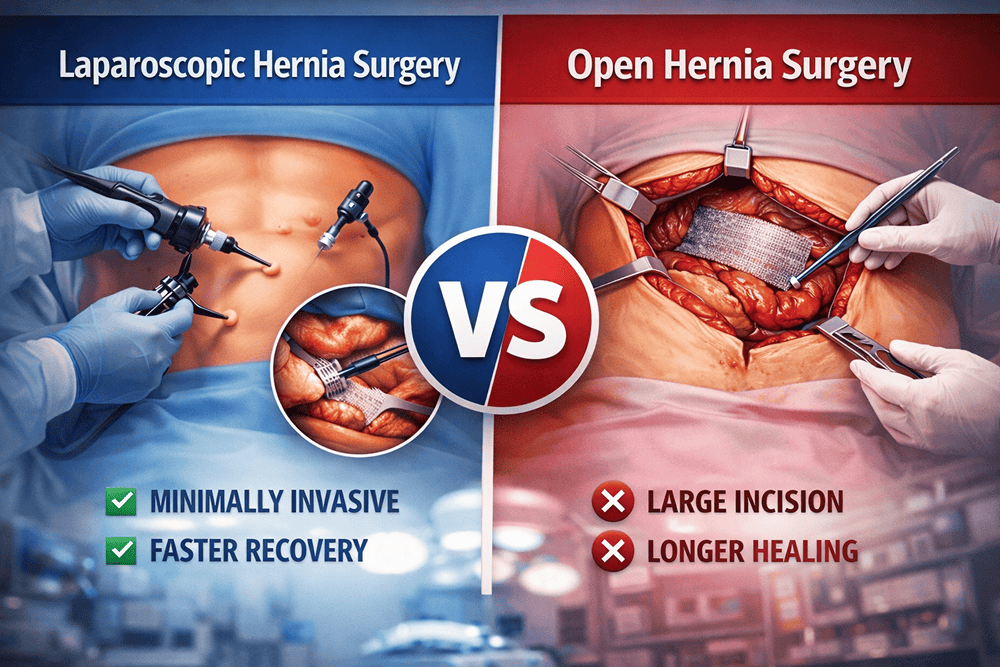
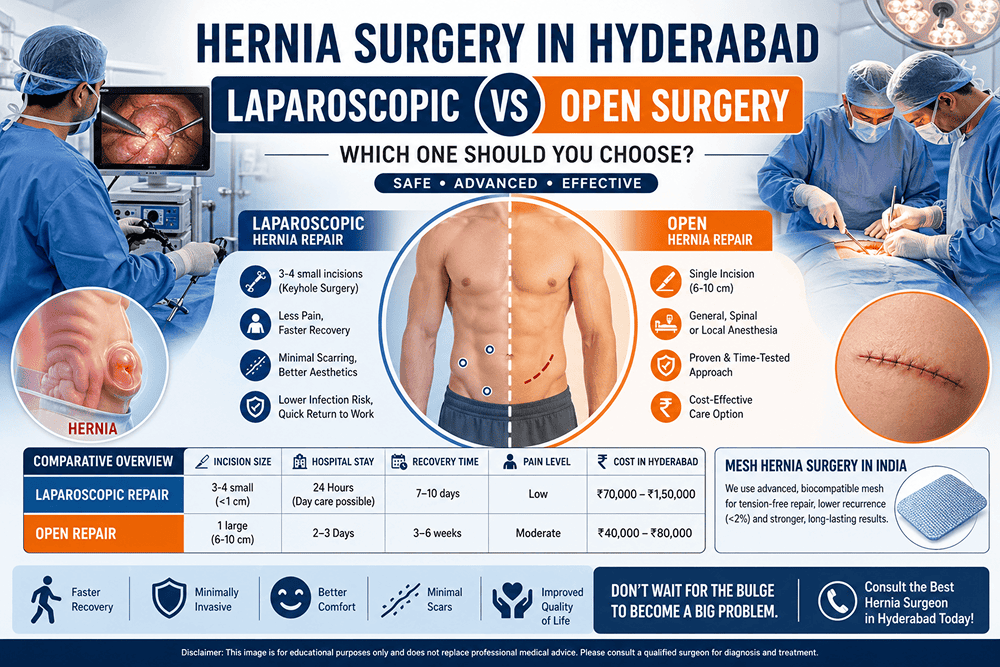
When choosing a surgeon, look for expertise in laparoscopic keyhole surgery. Modern Hernia Treatment in Hyderabad has evolved significantly. Instead of the traditional large incisions of the past, surgeons now use minimally invasive techniques that offer:
Minimal Scarring: Tiny incisions that heal quickly.
Reduced Pain: Less trauma to the surrounding muscles.
Faster Recovery: Most patients return to desk work within 3–5 days.
A qualified Hernia Specialist will likely use a "tension-free" repair, involving a medical-grade mesh to reinforce the weak area, significantly lowering the chance of the hernia coming back.
What to Expect During Your Consultation
When you visit the best hernia surgeon in Hyderabad, the process is straightforward:
Physical Exam: The doctor will ask you to cough or strain while they palpate the bulge.
Imaging (if needed): In some cases, an ultrasound or CT scan is used to see the exact size of the hernia and check for multiple defects.
Treatment Planning: You will discuss whether a laparoscopic or open approach is best for your specific case.
Recovery Tips for the Active Hyderabadi Man
Post-surgery, the goal is to get you back to your routine safely. You’ll be encouraged to walk the very next day. However, you’ll need to avoid heavy lifting (like gym squats or moving furniture) for about 4–6 weeks to let the mesh incorporate into your tissue.
Summary: Don't Let a Small Bulge Become a Big Problem
That "weird lump" might not hurt much now, but it is a signal from your body that a structural repair is needed. Taking care of it early ensures a simpler surgery and a much faster trip back to your normal life.
If you are looking for an expert opinion, don't delay. Consulting a specialist early can be the difference between a planned 30-minute procedure and an emergency surgery.
Take the Next Step Toward Relief
Stop wondering and start healing.
If you’ve noticed a bulge or persistent groin discomfort, our experts are here to help. Get a precise diagnosis and explore the latest minimally invasive treatment options today.
Conclusion
Q: Can I wear a hernia belt instead of having surgery?
A: A hernia belt (truss) can provide temporary support and may help with symptoms, but it does not fix the hole in the muscle. Surgery is the only definitive cure for a hernia.
Q: How much does hernia surgery cost in Hyderabad?
A: The cost varies based on the type of hernia and the surgical approach (laparoscopic vs. open). Generally, it is quite affordable compared to global standards, and most health insurance plans cover the procedure.
Q: Is a hernia a sign of being "out of shape"?
A: Not necessarily. While obesity is a risk factor, even very fit athletes can get hernias due to intense core pressure or a natural genetic weakness in the abdominal wall.