Understanding Weight Loss
Understanding the symptoms, causes, and available treatment options is an important first step. Every patient is different, so the right treatment depends on individual symptoms and medical evaluation.
When Should You Consult a Doctor?
If symptoms continue, become severe, or start affecting your daily activities, it is important to consult a qualified medical professional for proper diagnosis and treatment.
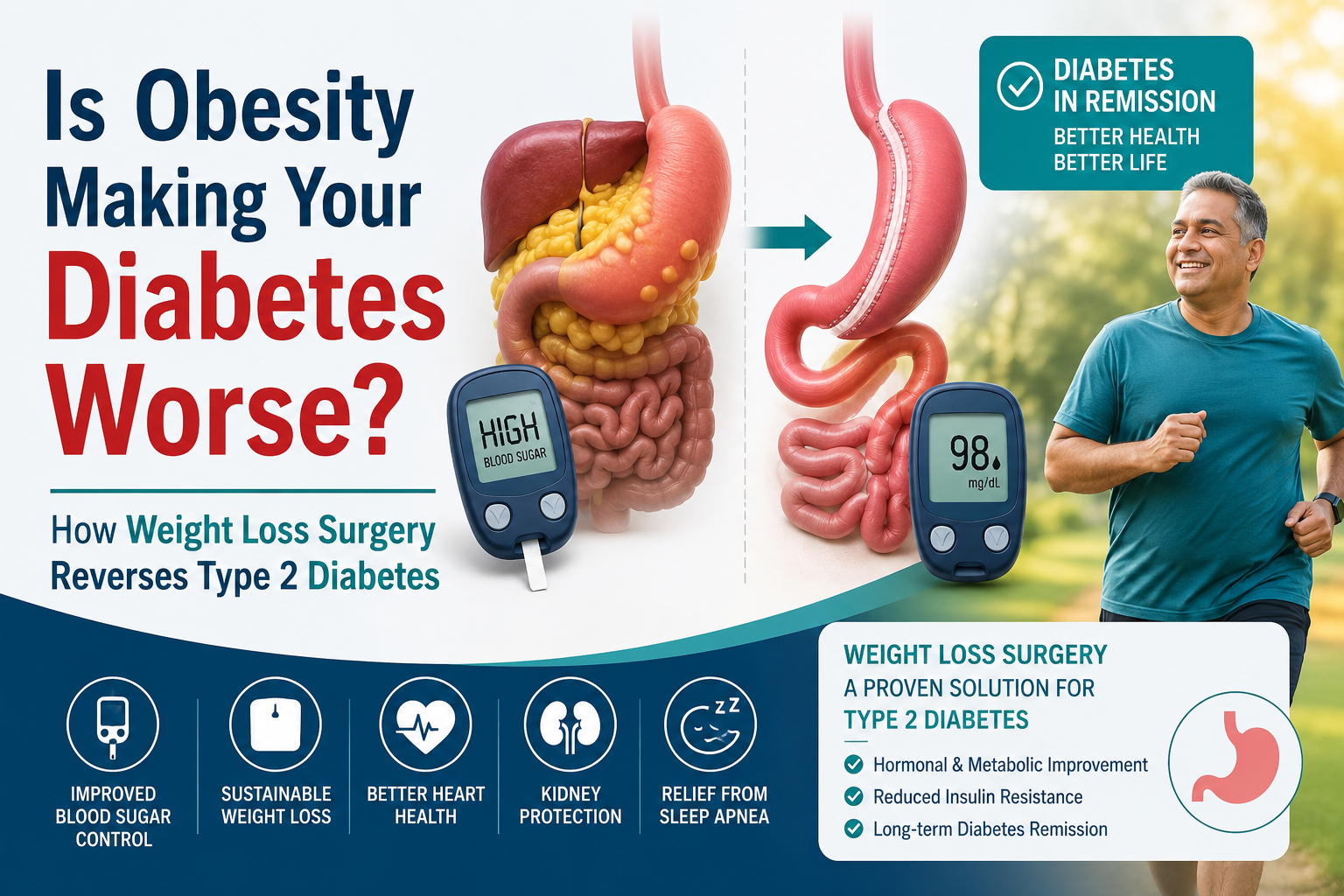
The intersection of obesity and Type 2 Diabetes (T2DM)—often clinically referred to as "Diabesity"—represents one of the most significant healthcare challenges in modern India. For patients in Hyderabad and across the country, managing blood sugar levels often feels like an uphill battle where diet and medication only provide temporary relief. Recent clinical data from 2025 and 2026 confirms that for individuals with a BMI over 30, obesity is not just a co-existing condition; it is the primary driver of insulin resistance and pancreatic exhaustion. However, a revolutionary shift in medical perspective now views metabolic surgery not as a last resort for weight loss, but as a frontline treatment for diabetes reversal.
The Biological Link: Why Obesity Accelerates Diabetes
To understand how weight loss surgery for diabetes in Hyderabad works, we must first look at the "Twin Cycle Hypothesis." This theory suggests that Type 2 Diabetes is caused by excess fat accumulating specifically in the liver and the pancreas.
The Liver Cycle: Excess fat makes the liver resistant to insulin. Consequently, the liver pumps out too much glucose, even while you sleep, leading to high fasting blood sugar.
The Pancreas Cycle: When the liver is overwhelmed, it passes excess fat to the pancreas. This "clogs" the beta cells responsible for producing insulin, eventually leading to their failure.
As obesity progresses, these cycles reinforce each other, making the body increasingly resistant to standard oral medications. This is why many patients find themselves needing higher doses of insulin over time.
Metabolic Surgery: More Than Just Weight Loss
One of the most common misconceptions is that bariatric surgery "cures" diabetes simply because the patient eats less. While weight loss is a key factor, the primary mechanism of diabetes remission after weight loss surgery is actually hormonal and metabolic.
The Incretin Effect
Within hours of procedures like a Roux-en-Y Gastric Bypass (RYGB) or a Sleeve Gastrectomy, the body undergoes a profound hormonal shift. The rerouting or reduction of the stomach alters the secretion of "incretins"—gut hormones like GLP-1 (Glucagon-Like Peptide-1).
Insulin Boost: These hormones signal the pancreas to produce more insulin in response to food.
Glucagon Suppression: They reduce the production of glucagon, a hormone that raises blood sugar.
Immediate Results: Many patients see their blood sugar levels normalize within days of surgery, often before they have even lost their first 5 kilograms.
Comparing the Options: Gastric Sleeve vs. Gastric Bypass for Diabetes
When looking for the best doctor for weight loss in Hyderabad, the consultation will likely focus on which procedure offers the best chance for long-term remission.
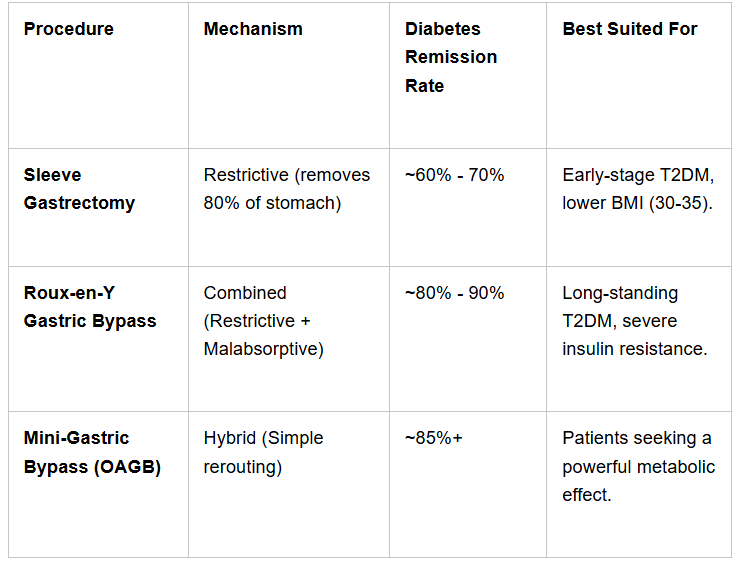
Clinical Note: A 2025 meta-analysis confirmed that Gastric Bypass remains the gold standard for metabolic surgery Type 2 Diabetes due to its superior impact on gut-brain signaling.
Eligibility: Who Should Consider Surgery for Diabetes Reversal?
The clinical guidelines in India have evolved. You no longer need to be "morbidly obese" to qualify for surgery if you have uncontrolled diabetes.
The Asian BMI Criteria (2026 Updates)
In India, the risk of metabolic syndrome occurs at a lower BMI than in Western populations.
BMI > 32.5: Surgery is strongly recommended if diabetes is present.
BMI 27.5 - 32.5: Surgery is considered medically necessary if blood sugar remains uncontrolled (HbA1c > 8.0) despite intensive medical management and a structured weight loss program in Hyderabad.
Expert Insight: "Early intervention is the key to a permanent cure. The longer a patient remains on high-dose insulin, the more their pancreatic beta cells permanent damage, reducing the chances of total remission."
The Benefits: Beyond the Glucose Meter
While gastric sleeve diabetes cure is a major focus, the systemic benefits of metabolic surgery transform a patient's entire health profile:
Cardiovascular Health: Significant reduction in the risk of stroke and heart attack.
Kidney Protection: Reversing diabetes early prevents diabetic nephropathy (kidney failure).
Sleep Apnea: Over 80% of patients see a resolution in obstructive sleep apnea.
Joint Pain: Reduced weight drastically lowers the mechanical stress on knees and the lower back.
What to Expect: The Pathway to Remission
Choosing to undergo bariatric surgery for diabetes in India involves a comprehensive, multi-disciplinary approach.
1. Pre-Operative Evaluation
You will work with a team including the best bariatric surgeon for diabetes in Hyderabad, a specialized nutritionist, and an endocrinologist. This stage involves:
Detailed HbA1c and C-peptide tests (to check remaining pancreatic function).
Psychological readiness assessment.
Optimization of current medications.
2. The Procedure
Modern bariatric surgeries are performed using Laparoscopic (Keyhole) or Robotic-Assisted techniques. This means:
Minimal scarring (3-4 tiny incisions).
Hospital stay of only 2 to 3 days.
Quick return to work (usually within a week).
3. Post-Operative "Honey Moon" Phase
The first 6 to 12 months after surgery is when the most rapid metabolic changes occur. Patients are placed on a structured protein-rich diet and a personalized weight loss program in Hyderabad to ensure muscle mass is preserved while fat is lost.
Addressing Safety and Professional Concerns
As a premier healthcare provider, we prioritize patient safety above all. While the word "surgery" can be daunting, the risk profile of modern bariatric surgery is now comparable to routine procedures like gallbladder removal or knee replacement.
Potential Risks to Discuss with Your Surgeon:
Nutritional deficiencies (preventable with daily supplements).
Temporary hair thinning (common during rapid weight loss).
Gallstones (often managed with temporary medication).
Finding the Right Care in Hyderabad
Hyderabad has emerged as a global hub for medical tourism and advanced metabolic care. When searching for the best doctor for weight loss in Hyderabad, look for centers that offer:
Multi-disciplinary Teams: Integrated care involving dieticians and physiotherapists.
Case Volume: Surgeons who perform high volumes of metabolic procedures specifically for diabetes.
Support Groups: Access to a community of patients who have successfully reversed their diabetes.
Conclusion
Frequently Asked Questions (FAQs)
1. Can weight loss surgery actually "cure" Type 2 Diabetes?
Medical professionals use the term "remission." Most patients achieve normal blood sugar levels without medication. Remission is most successful when surgery is performed within the first few years of diagnosis before the pancreas is permanently damaged.
2. How soon can I stop my diabetes medication after surgery?
Many patients stop or significantly reduce insulin within 24 to 48 hours. This is due to immediate hormonal changes in the gut that improve insulin sensitivity, occurring even before significant weight loss begins.
3. Is the procedure safe for high-risk diabetic patients?
Yes. Modern laparoscopic and robotic surgeries are highly safe, with risk levels comparable to routine gallbladder surgery. In fact, the risk of remaining obese and diabetic is statistically much higher than the risk of the surgery itself.
4. How does metabolic surgery differ from a standard weight loss program?
A weight loss program in Hyderabad focuses on calories, while metabolic surgery changes your biology. It alters gut hormones (like GLP-1) to reset your metabolism, making it a medical treatment for diabetes rather than just a lifestyle change.
5. What is the "best" surgery for diabetes reversal?
While the Gastric Sleeve is effective, the Roux-en-Y Gastric Bypass is often considered the gold standard for diabetes reversal. It offers a 80-90% remission rate by directly rerouting the digestive path to maximize hormonal impact.
Conclusion: A Future Without Insulin
Obesity is a progressive disease, and Type 2 Diabetes is its most dangerous complication. If you are struggling with a BMI over 28 and find that your medications are no longer enough, surgery for diabetic obese patients in India offers a scientifically proven path to freedom.
Diabetes remission is no longer a "lucky" outcome—it is a predictable medical result of correcting the body’s underlying metabolic signaling.
Take the First Step Toward Reversal
Don't wait for complications like vision loss or kidney issues to set in. Our clinical team specializes in metabolic surgery for Type 2 Diabetes and comprehensive weight loss programs in Hyderabad.
Disclaimer: This content is for educational purposes and should not replace professional medical advice. Please consult a qualified surgeon for a personalized diagnosis.