Understanding Piles Treatment
Understanding the symptoms, causes, and available treatment options is an important first step. Every patient is different, so the right treatment depends on individual symptoms and medical evaluation.
When Should You Consult a Doctor?
If symptoms continue, become severe, or start affecting your daily activities, it is important to consult a qualified medical professional for proper diagnosis and treatment.
For many, the first sign of a hemorrhoid—scientifically known as piles—is a minor inconvenience. A streak of blood or a brief moment of discomfort is often ignored or treated with over-the-counter ointments. However, proctologists and gastrointestinal specialists emphasize a critical clinical boundary: the shift from "manageable" to "advanced."In the medical landscape of piles treatment in Hyderabad, we frequently see patients who have crossed the threshold into Grade 3 and Grade 4 hemorrhoids. At this stage, the condition is no longer a surface-level irritation but a structural failure of the anal cushions. Understanding these warning signs is not just about comfort—it is about preventing complications like strangulation, infection, and chronic anemia.
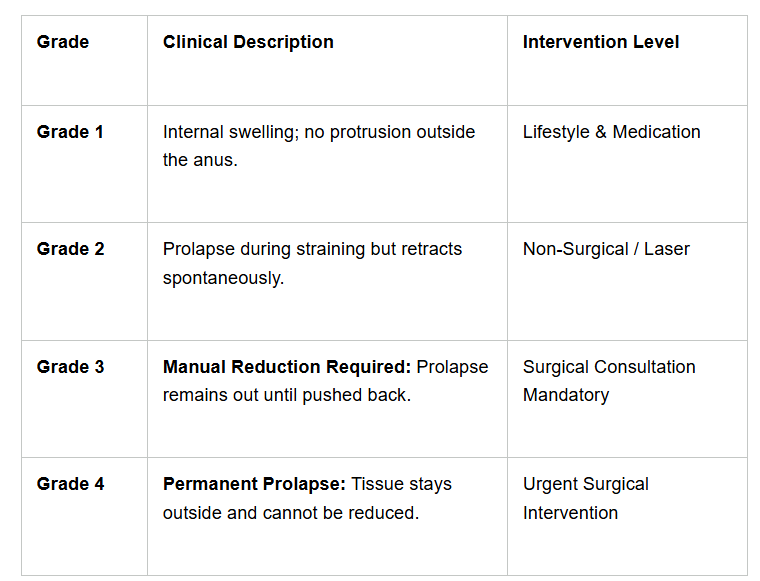
Understanding the Clinical Progression: The Grading System Explained
Before identifying the warning signs, patients must understand the piles grading India standard used by surgeons to determine when surgery becomes a medical necessity.
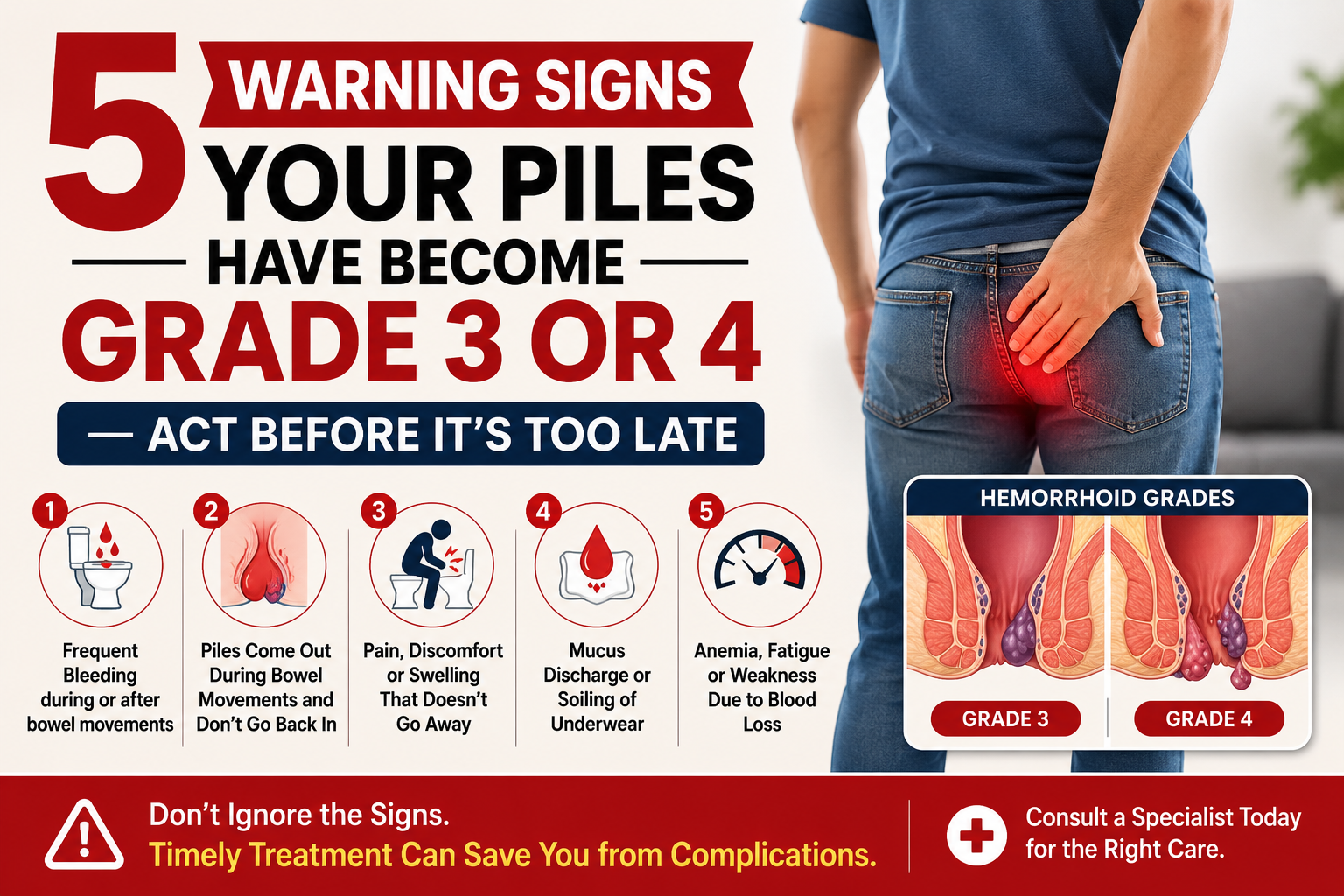
The 5 Warning Signs of Advanced (Grade 3 & 4) Piles
Sign 1: The Necessity of "Manual Reduction"
The definitive hallmark of Grade 3 piles symptoms is the loss of spontaneous retraction. In earlier stages, the hemorrhoidal tissue might emerge during a bowel movement and slip back inside naturally. In Grade 3, the connective tissues (Treitz’s muscle) have weakened significantly.
If you find yourself having to manually push a large piles lump outside back into the anal canal, the condition is now a mechanical failure. This is a clear indicator that the "wait and watch" approach is no longer viable.
Sign 2: Chronic Mucoid Discharge and Perianal Itching
As piles progress to Grade 4, the anal sphincter is often unable to close completely due to the presence of the prolapsed mass. This leads to the leakage of mucus from the rectal lining.
This moisture, combined with fecal particles, causes Pruritus Ani (persistent itching). For patients in Hyderabad, where humidity can exacerbate skin irritation, this often leads to secondary fungal infections and skin breakdown. If you are experiencing constant dampness in your undergarments, your piles have likely reached an advanced stage.
Sign 3: The Transition from Discomfort to "Thrombosis" and Pain
Internal hemorrhoids are generally painless because they originate above the dentate line, where nerve endings are sparse. However, when a Grade 4 pile stays outside, the anal sphincter muscle may constrict around it, cutting off blood supply. This is known as strangulated hemorrhoids.
When blood clots form within these prolapsed vessels (Thrombosed Piles), the pain becomes acute and throbbing. This is a medical emergency that requires immediate attention at a piles hospital in Hyderabad.
Sign 4: Splashing Bleeding (The Anemia Risk)
While Grade 1 piles may cause minor spotting, Grade 3 and 4 hemorrhoids often involve "arterial-like" bleeding. This isn't just a streak on the tissue; it is a visible splash in the toilet bowl. Over weeks or months, this consistent blood loss leads to Iron Deficiency Anemia.
Symptoms of Piles-Induced Anemia:
Unexplained fatigue and lethargy.
Paleness of the skin and gums.
Shortness of breath during minor physical exertion.
Sign 5: Incarceration and Inability to Sit
At Grade 4, the piles are "incarcerated." They are stuck outside, and the tissue begins to swell and potentially undergo necrosis (tissue death). At this point, even simple actions like sitting on a chair or walking become excruciating. This sign is a final warning that the condition has moved from a chronic issue to an acute surgical requirement.
Why Conservative Management Fails at This Stage
Many patients wonder: Can I cure Grade 3 piles with fiber and water?
The answer from a clinical perspective is generally no. While a high-fiber diet prevents the condition from getting worse, it cannot repair the stretched and torn ligaments that allow the prolapse. For prolapsed piles treatment, the goal shift from "softening stools" to "removing or repositioning tissue."
Advanced Piles Treatment in Hyderabad: The Modern Approach
The fear of traditional "open surgery" (Hemorrhoidectomy) often keeps patients away from the doctor. However, as the best hospital for piles treatment in Hyderabad, we utilize minimally invasive technologies that offer a near-painless experience.
Laser Piles Treatment (LHP)
Laser Hemorrhoidoplasty is the most sought-after piles treatment in Hyderabad.
The Procedure: A laser fiber is inserted into the hemorrhoidal mass. The energy causes the vessels to shrink and close without the need for scalpels or stitches.
The Benefit: Since there is no open wound, the risk of infection is near zero, and patients are often back to work in 48 hours.
Stapled Hemorrhoidopexy (MIPH)
For Grade 3 patients, the Stapler surgery is highly effective. It involves "lifting" the prolapsed tissue back into its original position and cutting off the blood flow to the excess mass. This procedure is performed in the "painless zone" of the rectum.
Choosing the Best Hospital for Piles Treatment in Hyderabad
When your condition reaches Grade 3 or 4, the choice of facility is paramount. An advanced proctology center should provide:
3D Endo-anal Ultrasound: To map the exact location of the vessels.
Diode Laser Technology: For precision-based tissue shrinkage.
Female Proctologists: For female patients who may feel more comfortable with specialized care.
Insurance Support: Quick TPA clearance for surgical procedures.
Expert Conclusion: Don't Let Fear Dictate Your Health
The transition from Grade 2 to Grade 3 is the most important window for intervention. In Hyderabad, where sedentary lifestyles and spicy dietary habits are common, piles worsening signs are often accelerated.
Waiting for Grade 4 only increases the complexity of the surgery and the length of recovery. Modern proctology has turned a once-feared surgery into a "day-care" procedure.
Clinical Warning: If you have to manually reduce your piles today, you are one bowel movement away from an incarcerated Grade 4 emergency. Act now.
Conclusion
Frequently Asked Questions
Which is the best hospital for piles treatment in Hyderabad?
The best hospital is one that offers a multi-disciplinary approach, combining expert proctologists with advanced laser and stapler equipment. Look for centers with high patient-satisfaction ratings for minimally invasive surgeries.
When is piles surgery necessary?
Surgery is medically indicated when piles reach Grade 3 or 4, when there is persistent heavy bleeding, or when the patient experiences thrombosed external or internal masses that do not respond to medication.
What is the cost of laser piles surgery in Hyderabad?
The cost varies based on the grade of piles and the technology used. Most advanced hospitals provide insurance coverage for these procedures under "Day Care" surgeries.
Disclaimer: This content is for educational purposes and should not replace professional medical advice. Please consult a qualified surgeon for a personalized diagnosis.